
There was a moment in the history of visual effects when Industrial Light & Magic faced an unusual dilemma.
For years, artists had relied on stop-motion and go-motion animation to create creatures and effects that could not be filmed in the real world. But throughout the late 1980s and early 1990s, ILM continued pushing the limits of computer-generated imagery. By the time Jurassic Park was released in 1993, the company had helped create a new standard for visual effects, and in the process, dramatically changed the future of the techniques it had previously relied upon.
The artists working in the industry had a choice: adapt to the new technology or risk being left behind.
Today, digital marketing is approaching a similar turning point.
For decades, search engine optimization, or SEO, has focused primarily on helping websites rank in traditional search engines such as Google. Businesses selected keywords, created website content, built links and worked to move higher on a search results page.
Those practices are not suddenly useless. Google remains an enormous part of how people find information online.
But search is no longer confined to a traditional list of blue links.
Consumers now discover businesses through social media, video platforms, online reviews, maps and AI-powered tools. Even Google itself is becoming increasingly driven by artificial intelligence. Google reported that its AI Overviews had reached 1.5 billion monthly users across 200 countries and territories by May 2025.
The question is no longer simply:
How do we rank on Google?
It is becoming:
How do we make sure our business can be found wherever people are searching?
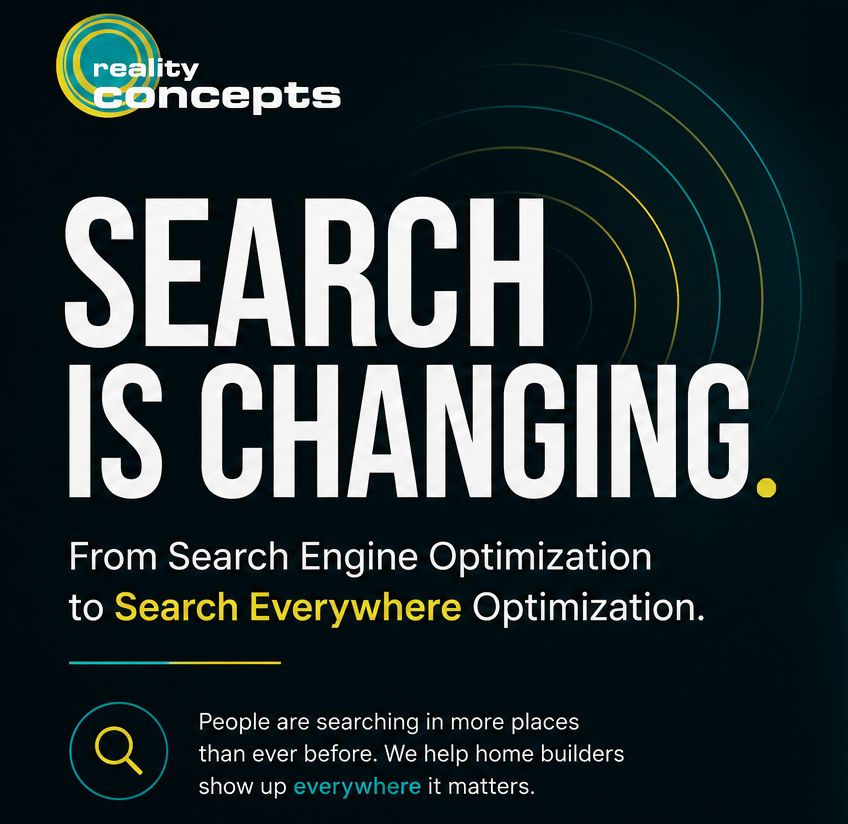
From Search Engine Optimization to Search Everywhere Optimization
At Reality Concepts, we are expanding the way we think about SEO.
Rather than focusing exclusively on Search Engine Optimization, we are approaching it as Search Everywhere Optimization: building visibility across the many platforms people now use to research, compare and make decisions.
Search Everywhere Optimization extends traditional SEO beyond Google and Bing to include social platforms, video, maps, directories and AI-powered search experiences.
That does not mean abandoning your website or traditional SEO. In fact, a strong website remains the foundation of the entire strategy.
It means recognizing that your prospective customers may encounter your business in several different places before they ever visit your website.
They might:
- Watch one of your videos.
- Find a community through social media.
- Read an online review.
- See your business referenced in an AI-generated answer.
- Search for your company directly after encountering it somewhere else.
Successful marketing now requires those pieces to work together.
AI Is Already Changing Search Behavior
AI search is not a hypothetical development waiting somewhere in the distant future. It is already changing how people find and consume information.
McKinsey reported in 2025 that approximately half of consumers were already using AI-powered search. Its research also found that 44% of people who had tried AI-powered search considered it their primary and preferred way to search online.
AI is also changing what happens after someone enters a traditional Google search.
A 2025 Pew Research Center analysis found that users who saw an AI-generated summary clicked a standard search result only 8% of the time. When no AI summary appeared, users clicked a traditional result 15% of the time, nearly twice as often.
That creates a significant challenge for businesses.
For years, the primary goal of SEO was to earn a high ranking and generate a click. Now, information about your company may be summarized before the user ever reaches your website.
Your business does not simply need to rank.
It needs to be understood, trusted and referenced.
What Does This Mean for Home Builders?
Home buyers are not always searching with short, predictable phrases anymore.
Instead of typing:
“New homes Denver”
They may ask an AI platform:
“Which new home communities near Denver offer ranch-style floor plans, energy-efficient features and access to parks?”
That is a much more detailed question, and answering it requires much more than repeating a keyword throughout a webpage.
AI-powered search tools look for clear, useful information that helps them understand:
- Where a community is located.
- Which floor plans are available.
- What price ranges are offered.
- Which features distinguish the homes.
- What amenities or attractions are nearby.
- Why a particular builder may be a good fit for the buyer.
For home builders, this means detailed community pages, accurate inventory, informative floor plan content, local area information, FAQs, videos and educational blog posts are becoming even more valuable.
The goal is not to create content merely for an algorithm.
It is to create content that genuinely answers the questions home buyers are asking.
Preparing for the Next Evolution of Search
SEO is not disappearing overnight, just as practical effects did not vanish the moment computer graphics appeared.
But the role of traditional SEO is changing.
Businesses that continue focusing exclusively on Google rankings may find themselves increasingly invisible in the other places where customers are searching. Those that adapt can build a broader, stronger digital presence, one that can be discovered across search engines, social media, video and AI-powered platforms.
At Reality Concepts, we are preparing for that change now.
Our approach combines a strong website foundation with useful content, video, social media and emerging AI-search strategies. The objective is simple: help our clients appear wherever their customers are looking.
Because the future of SEO is not about being visible in only one search engine.
It is about being visible everywhere that matters.
Is Your Marketing Ready for the Future of Search?
Reality Concepts helps home builders create websites, content and digital marketing strategies designed for the way today’s home buyers search.